
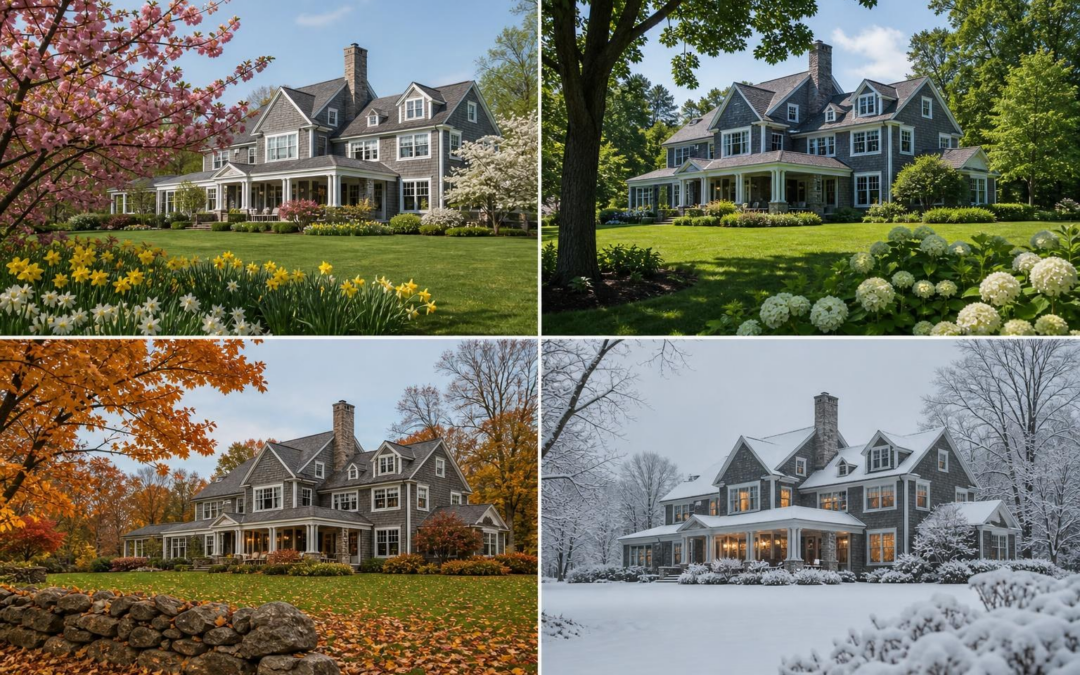
New Jersey throws everything at a house. Summers push past 90°F with humidity that makes the air feel like a wet blanket. Winters dip into the teens, sometimes lower in the northwestern highlands, with freeze-thaw cycles that crack foundations and buckle driveways. Then there’s the coast, where salt spray, nor’easters, and the occasional hurricane reminder keep builders honest. Designing a custom home for New Jersey’s four seasons means thinking about every material, every system, and every square foot as if it has to perform under wildly different conditions, because it does. A house that excels in July but fails in January isn’t a well-designed house. It’s a compromise. And with energy costs, insurance premiums, and building codes all tightening in 2026, the stakes for getting this right have never been higher. The good news: the tools, materials, and design strategies available today make it entirely possible to build a home that handles everything the Garden State dishes out, comfortably and efficiently.
Adapting to New Jersey’s Diverse Climate Zones
New Jersey packs a surprising amount of geographic variety into a small state. The climate in Cape May County is meaningfully different from the climate in Sussex County, and a custom home design should reflect that. A one-size-fits-all approach misses the specific stresses your property will face, whether that’s coastal wind loads or inland snow accumulation that can exceed 40 inches annually in the northern highlands. Understanding your microclimate is the first real design decision you’ll make.
Coastal Resilience for Jersey Shore Properties
Shore properties face a unique combination of threats: salt air that corrodes metal fasteners and fixtures, wind-driven rain that finds every gap in a building envelope, and flood risk that shapes everything from foundation height to mechanical system placement. FEMA flood maps were updated again in 2025, and many Shore communities now require elevated foundations with breakaway walls on the ground level. Stainless steel or hot-dipped galvanized hardware isn’t optional here: it’s essential. Even the HVAC condenser placement matters, since a unit sitting at grade level in a flood zone is a unit you’ll be replacing after the next big storm. Designing for the coast means assuming the worst weather will arrive and building so it barely registers inside.
Inland Considerations for the Highlands and Valleys
The northwestern part of the state deals with a different set of pressures. Elevation changes create cold pockets where frost arrives earlier and lingers longer. Snow loads are heavier, which affects roof pitch, truss engineering, and gutter design. Soil conditions in the Highlands often involve rock ledge, which complicates foundation work but can actually provide excellent bearing capacity if the site is properly evaluated. Homes here benefit from steeper roof pitches (6:12 or greater) that shed snow before it accumulates to dangerous weights, and from south-facing orientations that capture passive solar heat during the long, cold months from November through March.
High-Performance Building Envelopes for Extreme Temperature Swings
The building envelope is where your home meets the weather, and in a state where outdoor temperatures can swing 100 degrees between seasons, this boundary has to work hard. A high-performance envelope does three things well: it resists heat transfer, it manages moisture, and it blocks air infiltration. Getting all three right is what separates a comfortable, efficient home from one that’s drafty in winter and muggy in summer despite running the HVAC nonstop.
Advanced Insulation Strategies for Winter R-Values
New Jersey falls in IECC Climate Zones 4A and 5A, and the 2024 energy code updates (now fully enforced in 2026) require minimum wall insulation values of R-20 for cavity-only or R-13 cavity plus R-5 continuous insulation. But minimums are just that. Many custom builders are now specifying R-25 to R-30 wall assemblies using a combination of closed-cell spray foam in the stud cavities and rigid exterior insulation board. This approach eliminates thermal bridging through the studs, which can account for 25% of a wall’s heat loss in a conventionally insulated home. Attic insulation targets of R-60 or higher are common in well-designed New Jersey custom homes, particularly in the northern counties where heating degree days are significantly higher.
Selecting Energy-Efficient Windows for Humidity and Frost
Windows are the weakest thermal link in any wall, and choosing the right ones for New Jersey’s climate requires balancing several competing priorities. You want a low U-factor (0.27 or better) for winter heat retention, but you also want a solar heat gain coefficient that’s low enough to prevent overheating in summer without blocking all the free solar warmth you’d welcome in January. Triple-pane units with argon or krypton gas fill and low-E coatings tuned for the mid-Atlantic climate hit this balance well. Frame material matters too: fiberglass and high-quality vinyl outperform aluminum in thermal performance, and they resist the condensation problems that plague metal frames during New Jersey’s humid summers and cold winters.
Smart HVAC and Air Quality for Year-Round Comfort
A well-designed HVAC system in New Jersey has to heat, cool, dehumidify, and ventilate, sometimes all in the same week during the shoulder seasons. The days of slapping a single thermostat on the wall and calling it done are over. Modern custom homes demand systems that respond to conditions room by room and floor by floor.
Zoned Heating and Cooling for Multi-Level Homes
HVAC zoning divides a home into independently controlled areas, each with its own thermostat and damper system. For a two-story or three-story New Jersey home, this is practically mandatory. The temperature difference between a ground floor and a second floor can be 8 to 10 degrees without zoning, which means someone is always uncomfortable. A properly zoned system with variable-speed air handlers adjusts output to match each zone’s actual demand, reducing energy waste by 20 to 30 percent compared to single-zone setups. Heat pump technology has improved dramatically: cold-climate mini-splits and ducted heat pumps now operate efficiently down to -13°F, making them viable even in the coldest parts of the state.
Dehumidification Systems for Mid-Atlantic Summers
New Jersey summers regularly push relative humidity above 70%, which creates comfort problems that air conditioning alone can’t fully solve. A standard AC system removes some moisture as a byproduct of cooling, but it’s not designed to dehumidify independently. Whole-house dehumidifiers, installed inline with the ductwork, pull moisture out of the air without overcooling the space. This is especially important in basements and lower levels, where moisture intrusion through concrete walls adds to the humidity load. A target indoor relative humidity of 45 to 50 percent protects both occupants and building materials from mold, wood rot, and dust mite proliferation.
Outdoor Living Spaces Designed for All Seasons
One of the genuine advantages of building custom in New Jersey is the ability to design outdoor spaces that extend your living area well beyond the traditional summer-only patio. With the right design choices, outdoor spaces can be usable from April through November, and some elements work year-round.
Screened Porches and Three-Season Rooms
A screened porch with a solid roof and ceiling fan turns a mosquito-plagued backyard into comfortable living space from spring through fall. Upgrading to a three-season room with glass panels that slide or swing open adds another month or two of usability on each end. The key detail most people overlook is the floor: a concrete slab with radiant heat tubing extends the season dramatically, keeping the space comfortable on cool October evenings without heating the entire outdoors. Ceiling-mounted infrared heaters are another cost-effective option that warms people directly rather than trying to heat the air.
Hardscaping for Snow Management and Drainage
Outdoor hardscaping in New Jersey needs to handle both heavy rain and snow accumulation. Permeable pavers allow snowmelt and rain to drain through rather than pooling or sheeting across walkways, reducing ice formation and eliminating the standing water problems that come with traditional concrete or asphalt. Heated driveway systems using hydronic tubing or electric cables under the paver surface eliminate the need for shoveling and salt application entirely, though they add $15 to $25 per square foot to installation costs. Proper grading away from the foundation is non-negotiable: a minimum slope of 6 inches over the first 10 feet prevents the water management headaches that plague so many existing New Jersey homes.
Material Selection for Durability and Aesthetics
Choosing exterior materials for a New Jersey custom home means finding products that look great and hold up under conditions that would destroy lesser materials within a decade. The freeze-thaw cycle is the silent killer: water enters tiny cracks, freezes, expands, and slowly destroys materials from the inside out. Coastal exposure adds salt corrosion to the equation. Your material choices need to account for both.
Weather-Resistant Siding and Roofing Options
Fiber cement siding has become the default choice for many New Jersey custom homes, and for good reason: it resists rot, insects, fire, and impact, and it holds paint far longer than wood. Engineered wood siding offers a more natural look with better dimensional stability than solid wood, though it requires more maintenance in coastal areas. For roofing, architectural asphalt shingles rated for 130 mph winds remain the most common choice, but standing-seam metal roofing is gaining ground fast. Metal roofs shed snow cleanly, resist wind uplift, last 50-plus years, and reflect solar heat in summer. The upfront cost premium of 40 to 60 percent over asphalt pays for itself in longevity and reduced maintenance. Impact-rated options are worth considering anywhere in the state, given the increasing frequency of severe hail events.
Maximizing Natural Light During Short Winter Days
New Jersey’s shortest days deliver barely 9 hours of daylight, and much of that arrives at low angles that standard window placement fails to capture. A custom home gives you the chance to design around the sun’s path rather than fighting it.
Strategic Window Placement and Solar Orientation
South-facing windows are the workhorse of passive solar design. In New Jersey’s latitude (roughly 40°N), a south-facing window with appropriate overhangs receives direct sun in winter when the sun angle is low (about 27 degrees at the solstice) while being shaded in summer when the sun climbs to 73 degrees. This isn’t theoretical: a well-oriented home with generous south-facing glass and thermal mass flooring (concrete, tile, or stone) can offset 15 to 25 percent of its heating load through passive solar gain alone. Skylights and sun tunnels bring light into interior rooms that windows can’t reach, and modern units with integral blinds and low-E coatings avoid the overheating and condensation problems that gave skylights a bad reputation in earlier decades.
Future-Proofing Your Garden State Home
Building a custom home in New Jersey that performs across all four seasons is about making smart, interconnected decisions: the envelope, the mechanical systems, the materials, and the site design all work together. No single choice carries the whole load. A high-performance envelope reduces your HVAC demands. Proper material selection reduces your maintenance burden for decades. Thoughtful orientation and window placement reduce your lighting and heating costs without any ongoing energy input at all.
The homes being built in New Jersey in 2026 that will still feel modern and comfortable in 2050 share a few common traits: they’re well-insulated, properly zoned, built with durable materials suited to their specific microclimate, and designed with enough flexibility to accommodate evolving technology. If you’re planning a custom build in the Garden State, start with your site’s specific climate challenges and work inward from there. The weather isn’t going to get simpler, but your home can absolutely be ready for whatever it brings.